AI Video Generation vs Traditional Video Editing

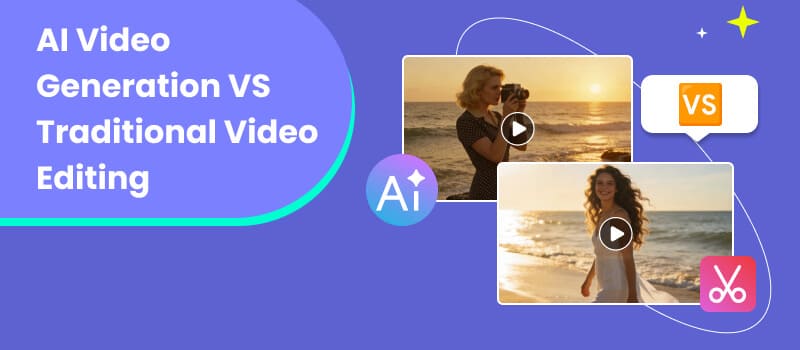
Traditional video editing revolves around timelines—cutting, trimming, layering clips, adjusting transitions, and refining details frame by frame. This workflow demands both technical skill and creative intuition. In contrast, AI video generation introduces a prompt-based paradigm. Instead of manually assembling clips, users describe the desired scene in natural language, and the system generates video output using advanced models such as diffusion and transformer-based architectures. This shift represents more than just a tool upgrade—it’s a fundamental change in how creators interact with media. Can AI truly replace the human touch in video production? Or is it better understood as a powerful assistant—enhancing efficiency without replacing creativity? The answer lies in understanding what each approach does best. In the following review, we will introduce AI video generation vs traditional video editing in detail.
Contents:
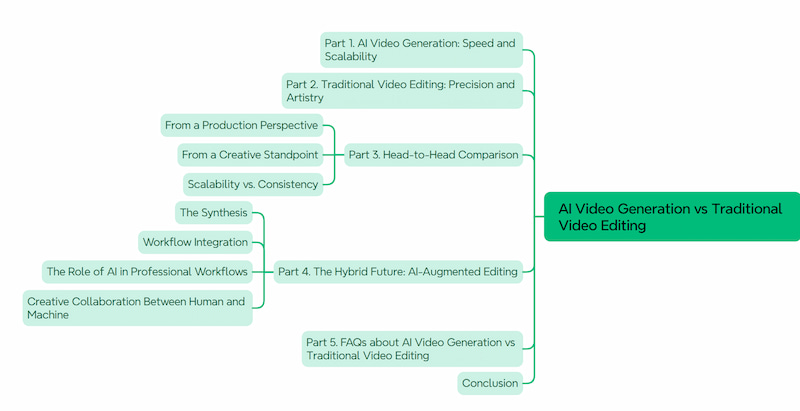
Part 1. AI Video Generation: Speed and Scalability
How It Works
In the comparison between AI Video Generation and Traditional Video Editing, AI video generation relies on technologies like diffusion models and text-to-video synthesis. These systems interpret prompts and generate visual sequences by predicting frames based on learned patterns from massive datasets.
Pros
- Rapid Prototyping
Creators can generate multiple video concepts in minutes, dramatically reducing ideation time. - Cost Efficiency
No need for cameras, actors, or locations—AI handles production digitally. - No Filming Required
Perfect for generating B-roll, explainer visuals, or abstract scenes without physical constraints.
Cons
- Limited Granular Control
Fine-tuning specific elements (e.g., exact gestures or camera angles) remains difficult. - Hallucinations
AI may produce visually inconsistent or unrealistic outputs. - Consistency Issues
Maintaining character identity or scene continuity across clips can be challenging.
Top Tools
- • Picwand
- • GoEnhance AI
- • OpenAI Sora
These platforms are pushing the boundaries of what AI-generated video can achieve, especially for short-form content.
Part 2. Traditional Video Editing: Precision and Artistry
The Human Element
Now, let’s talk about the latter one between AI Video Generation and Traditional Video Editing. Traditional editing is deeply rooted in storytelling. Editors shape narratives through pacing, rhythm, transitions, and emotional cues—elements that require human sensitivity and experience.
Pros
- Absolute Control
Every frame, cut, and effect can be precisely adjusted. - Brand Consistency
Essential for professional productions where visual identity matters. - High-Fidelity Output
Delivers polished, cinematic-quality results suitable for film and broadcast.
Cons
- Time-Intensive
Editing can take hours or even days, depending on complexity. - Steep Learning Curve
Mastering professional tools requires training and experience. - High Costs
Equipment, software licenses, and skilled labor add up quickly.
Top Tools
- • Fotor Video Enhancer
- • DaVinci Resolve
- • Final Cut Pro
These industry-standard tools remain indispensable for professional editors.
Part 3. Head-to-Head Comparison
This comparison highlights a crucial insight: the two approaches serve fundamentally different purposes rather than competing directly.
Deeper Analysis: Choosing the Right Approach
While the table above highlights the core differences between AI video generation and traditional video editing, the real decision often depends on your specific goals, timeline, and content strategy.
• From a Production Perspective
AI video generation dramatically shortens the time from idea to output. This makes it especially valuable in fast-paced environments such as social media marketing, where trends change rapidly and speed is critical. In contrast, traditional editing prioritizes refinement and detail, making it better suited for projects where quality outweighs speed.
• From a Creative Standpoint
AI tools are still largely constrained by prompts. While they can generate visually impressive results, they often lack intentional storytelling and emotional depth. Traditional editing, on the other hand, allows creators to carefully shape narrative arcs, control pacing, and evoke specific audience responses—something AI cannot fully replicate yet.
• Scalability vs. Consistency
AI excels at producing large volumes of content quickly, but maintaining visual and narrative consistency across multiple outputs can be challenging. Traditional editing ensures consistency, particularly for brand identity and long-form storytelling, but at the cost of time and resources. Ultimately, the choice is not about which method is superior, but which one aligns better with your production needs. Many creators are now adopting a blended approach—leveraging AI for speed and ideation, while relying on traditional editing for final quality and cohesion.
Part 4. The Hybrid Future: AI-Augmented Editing
The Synthesis
Rather than replacing traditional workflows, AI is being integrated into AI Video Generation and Traditional Video Editing. Modern editing software increasingly includes AI-powered features such as:
- • Automatic background removal (AI masking)
- • Generative fill for missing elements
- • Auto-captioning and transcription
- • Scene detection and smart cuts
Workflow Integration
A common emerging workflow looks like this:
- • AI generates the first draft (concept visuals, rough cuts)
- • Human editors refine the output (timing, storytelling, branding)
- • Final polish ensures quality and coherence
The Role of AI in Professional Workflows
Beyond basic automation, AI is increasingly becoming a strategic tool in professional editing pipelines. Editors are no longer just cutting footage—they are orchestrating intelligent systems to accelerate repetitive tasks and unlock new creative possibilities.
For example, AI can now assist in:
- • Shot selection by identifying the best takes automatically
- • Color matching across clips to maintain visual consistency
- • Voice cloning and dubbing, enabling multilingual content production
- • Object tracking, which simplifies complex visual effects workflows
These capabilities significantly reduce manual workload, allowing creators to focus more on storytelling and less on technical execution.
Creative Collaboration Between Human and Machine
The hybrid model is not just about efficiency—it’s about co-creation. AI can generate multiple visual interpretations of a concept, giving editors a broader creative starting point.
Instead of beginning with a blank timeline, creators now start with:
- • AI-generated drafts
- • Style variations
- • Scene simulations
From there, human editors step in to refine tone, pacing, and emotional impact. This collaboration leads to faster iteration cycles and more experimental storytelling. This hybrid model combines the speed of AI with the artistry of human editing—arguably the best of both worlds.
Part 5. FAQs about AI Video Generation vs Traditional Video Editing
Q: Is AI video generation suitable for professional filmmaking?
A: Not yet as a standalone solution. While improving rapidly, it lacks the consistency and control required for high-end productions.
Q: Can AI completely replace video editors?
A: No. AI automates tasks but cannot replicate human storytelling, emotional nuance, and creative judgment.
Q: How does Picwand fit into this landscape?
A: Tools like Picwand can complement video workflows by enhancing visuals, generating assets, and streamlining creative processes.
Conclusion
Some people might ask that in the competition of AI Video Generation vs Traditional Video Editing, who wins? Neither AI video generation nor traditional editing “wins” outright. They serve different roles in the creative ecosystem. AI is the Efficiency Engine — fast, scalable, and cost-effective; Humans are the Creative Director — intentional, expressive, and precise. The future of video creation belongs to hybrid creators—those who understand both prompt-based generation and traditional editing techniques. Mastering both is no longer optional; it’s the new competitive edge. In this evolving landscape, the question is no longer AI vs human, but rather how well can you combine the two?
AI Picwand - Anyone Can be A Magician
Get Started for Free