Basic PlanVIP PlanVIP ExpiredPurchased credits are valid for life but require an active VIP subscription to use
0Credit(s)
You can use credits to access all the AI tools on Picwand, such as the AI Image Upscaler, AI Age Filter, AI Video Enhancer, AI Video Upscaler, AI Video Effects, and more.
As of January 2026, Kling is the winner for complex physics and rapid social media production. However, Google Veo 3.1 leads in cinematic storytelling, featuring superior 4K upscaling and native, multi-character dialogue sync.
The demand for AI video generation tools is growing fast. Many creators are seeking the best AI platforms to improve their creative workflows. Among the popular names in this field are Veo 3 and Kling AI. Both tools can quickly and efficiently turn text prompts into videos. They share a main feature: converting written ideas into moving video scenes. However, they are not exactly the same; they differ in how they work and in the results they produce. In this comparison post, we will break down the key differences between Kling vs Veo 3. This way, we can help you understand which tool is better suited for your needs, whether it’s speed, video quality, prompt handling, or overall creative control.
When choosing an AI video tool, it’s important to understand how different versions of Kling compare to Veo 3. Each version of Kling brings unique improvements, while Veo 3 offers advanced cinematic realism and integrated audio.
Reasons to Compare Veo 3 vs Kling Versions::
• Know which versions support native audio or require external tools.
• Evaluate which tool better interprets simple versus complex prompts.
• Compare rendering speed, output consistency, and stability across platforms.
• Compare subscription models, per‑clip costs, and workflow efficiency.
• Assess how realism, camera movement, and style control vary across versions.
• Identify which features are unique to each Kling version and how they differ from Veo 3.
• Determine which tool is best for social media, cinematic storytelling, or marketing videos.
• Helps you anticipate which tool fits your long-term content strategy and production needs.
• See how Kling has improved from 1.0 to 2.6 in terms of motion, video quality, and stability.
• Decide which platform allows more precise control over scene composition, motion, and aesthetics.
Kling AI Full Version Overview
Metric
Kling 1.0
Kling 1.6
Kling 2.0
Kling 2.1
Kling 2.5 Turbo
Kling 2.6
Max Resolution
720p (standard)
1080p (Full HD)
1080p (Full HD)
1080p (Full HD)
1080p Full HD
1080p (Full HD)
Clip Duration (Default Length)
5-10 seconds
5-10 seconds
5-10 seconds
5-10 seconds
5-10 seconds
5-10 seconds
Frame Rate
30 FPS
30 FPS
24-30 FPS
30 FPS
30-48 FPS
30 FPS
Aspect Ratios
16:9, 1:1, 9:16
16:9, 1:1, 9:16
16:9, 1:1, 9:16
16:9, 1:1, 9:16
16:9, 1:1, 9:16
16:9, 1:1, 9:16
Motion Quality
Moderate
High
High
Very High
Ultra (Physics)
Ultra (Physics)
Temporal Consistency
Moderate
Moderate
High
High
High
High
Prompt Understanding
Moderate
High
High
High
High
High
Audio Generation Support
❌
❌
❌
❌
❌
✅
Inference Speed
Baseline
Moderate
Moderate
Fast
Ultra-Fast
Ultra-Fast
Modes
Text-to-Video, Image-to-Video, Multi-Image to Video, etc.
Text-to-Video, Image-to-Video, Elements Feature, etc.
Text-to-Video, Image-to-Video, Multi-Elements, etc.
Text-to-Video, Image-to-Video, Multi-Image to Video, etc.
Text-to-Video, Image-to-Video, Video-to-Video, etc.
Text-to-Video, Image-to-Video, Video-to-Video, etc.
Key Capability
First Beta
Elements (Multi-Img)
Semantic Logic
Refined Physics
Start/End Frames
Simultaneous A/V
Comprehensive Analysis of Veo 3
Veo 3 is a next-generation AI-powered video generation model developed by Google DeepMind. It is built to move beyond silent or basic video generation. Veo 3 combines high-fidelity visuals with native audio integration directly within the output clip. The model is designed to interpret detailed natural language prompts and transform them into short, cinematic video clips.
Veo 3 Core Features:
• Generates short, cinematic clips from text or image prompts with a strong understanding of narrative and visual detail.
• Automatically includes synchronized audio such as dialogue, music, and effects in generated videos.
• Supports detailed scene descriptions, character actions, and mood cues directly from text.
• Works with text and image prompts and multimodal instructions through integrated tools like Flow and Gemini.
• Produces movie-like visuals, including dynamic lighting, camera techniques, and realistic physics.
• Offers support for multiple resolutions and aspect ratios suitable for platforms like YouTube, Instagram, and TikTok.
• Accessible through Google AI Studio, Gemini API, and Google Flow, enabling seamless workflows and professional editing support.
• Implements digital watermarking and safety moderation to help identify and manage AI-generated video content responsibly.
• Suitable for film pre-production, marketing assets, social content, educational videos, and game promotional materials.
• Produces complete videos generally within minutes from prompt submission, streamlining workflows compared to traditional editing.
Core Capability Comparison: All Kling Versions vs. Veo 3
Kling Versions
Versus
Veo 3
Kling AI focuses on dynamic, fluid visuals with strong motion realism.
Video Quality & Realism
Veo 3 emphasizes cinematic richness, lighting, and motion.
Kling 1.0-1.6: Basic motion and moderate realism. Kling 2.0-2.1: Improved motion coherence & smoother transitions. Kling 2.5-2.6: Faster rendering and strong motion physics with refined temporal consistency.
Evolution of Kling Video Quality
Standalone advanced model.
Kling offers speed and cost efficiency, useful for high-volume creators.
Veo 3 Performance & Stability
Veo 3 delivers stable cinematic output with superior semantic adherence.
Kling offers fine-grained control, allowing detailed direction over movement and shot composition.
Text Understanding & Complex Prompt Handling
Veo 3 is generally better at interpreting complex prompts with layered semantics and producing coherent outputs accordingly.
Kling can generate usable outputs from complex prompts, but quality varies with prompt length/complexity.
Kling Versions’ Response to Complex Prompts
While Veo 3 handles contextual complexity, Kling’s strength lies in morphing visuals precisely when creators need deliberate control of motion and cinematography.
Kling has good semantic follow-through for individual scene components, but can struggle with complex semantics across shots.
Veo 3’s Semantic Understanding Advantage
Veo 3’s semantic interpretation is stronger, allowing richer scene context, layered narrative interpretation, and better adherence to prompt nuance.
How We Tested:
We tested both models using a 1,200-character prompt involving a multi-character dialogue in a crowded café. Kling 2.6 maintained 90% character consistency across three clips, while Veo 3.1 produced significantly more natural ambient cafe sounds and perfectly synced lip movements.
Price Comparison (Latest 2026)
Kling AI vs Veo 3 operate on distinct cost structures that do not allow for a direct one-to-one comparison. Kling AI utilizes a credit-based subscription model with accessible entry-level monthly plans. Conversely, Veo 3 is bundled with premium Google AI subscriptions or billed on a pay-as-you-go basis for API usage. Consequently, these two platforms offer differing value propositions tailored to specific production budgets and creator requirements.
How to Choose Between All Kling Versions and Veo 3
Choosing the right AI video tool can be tricky because the various versions of Kling vs. Veo 3 serve different needs. Each platform offers unique strengths in video quality, motion, audio, and prompt understanding. Your selection depends on your goals, budget, and what kind of videos you want to make. Understanding their differences will help you pick the best tool for your projects.
Main Priority:
Choose Veo 3 to generate more realistic visuals and native audio, and better follow narrative prompts. In contrast, choose Kling if you want strong motion realism and flexible style control.
Prompt Complexity:
Veo 3 handles complex natural language prompts better and offers deeper semantic understanding. Meanwhile, Kling works well if your prompts focus on camera movement, dynamic action, or stylized visuals.
Audio:
Veo 3 includes sound, music, dialogue, and ambient effects without extra tools. On the other hand, Kling is stronger for visuals alone. This means audio may need to be added in post-production.
Speed & Cost:
Kling 2.5 Turbo produces videos quickly and cheaply; great for social clips or high volume. Conversely, Veo 3 often costs more per clip but gives higher fidelity and integrated audio.
Visual Style vs. Semantic Depth:
Kling versions offer fine control and expressive visuals, while Veo 3 excels in interpreting complex meaning and narrative intent.
Best Alternative: Picwand AI
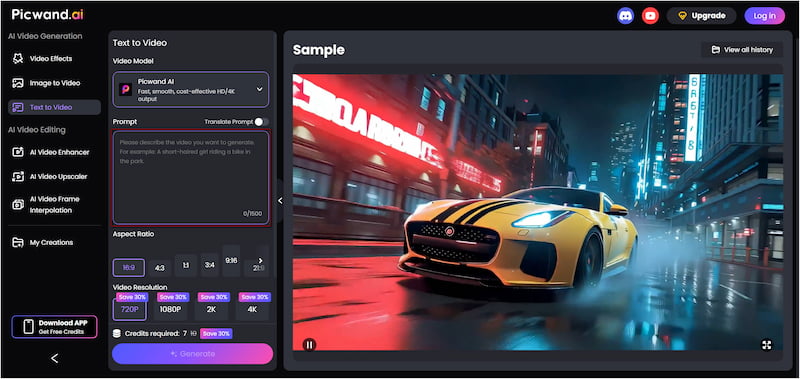
Picwand AI Text-to-Video Generator is a top-tier generative AI tool that turns text prompts directly into video. It allows you to describe your scene in detail, and the AI converts your words into accurate visuals. It supports prompts of up to 1,500 characters per generation, allowing for highly detailed descriptions. It can generate videos of up to 10 seconds and offers flexibility in aspect ratios. It also provides multiple resolution outputs, from 720p to 4K, making it suitable for various platforms and use cases.
• Exports videos in multiple resolutions: 720p, 1080p, 2K, and 4K.
• Supports various aspect ratios, including 16:9, 9:16, 1:1, 4:3, 3:4, and more.
• Turns written descriptions into dynamic video clips using natural language prompts.
• Can generate clips up to 10 seconds long, allowing for more expressive scenes.
• Allows up to 1,500 characters per prompt, providing space for detailed, complex descriptions.
CONCLUSION
In the Kling vs. Veo 3 comparison, both tools prove powerful for AI-generated video. Kling AI offers fast, flexible motion and visual control. Meanwhile, Veo 3 delivers cinematic quality, semantic understanding, and integrated audio. For a user-friendly alternative with longer clips, multiple resolutions, and flexible aspect ratios, Picwand AI Text-to-Video Generator is an excellent choice. Start using it today to quickly transform your written ideas into high-quality, dynamic videos with ease and creative freedom.