Basic PlanVIP PlanVIP ExpiredPurchased credits are valid for life but require an active VIP subscription to use
0Credit(s)
You can use credits to access all the AI tools on Picwand, such as the AI Image Upscaler, AI Age Filter, AI Video Enhancer, AI Video Upscaler, AI Video Effects, and more.
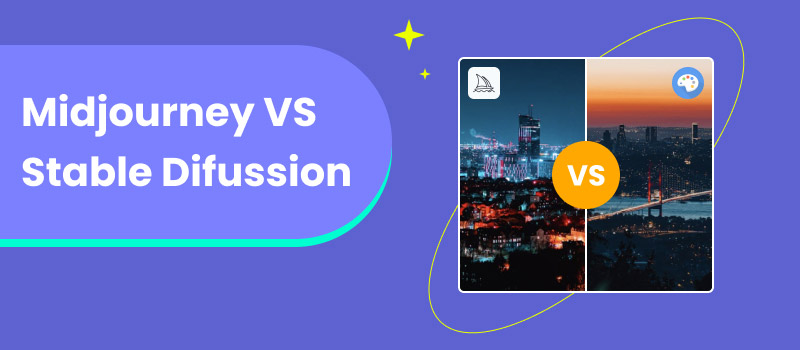
Midjourney and Stable Diffusion are currently two of the most popular AI image generation tools, but they differ significantly in core philosophy, technical architecture, and usage model. In simple terms, Midjourney is a polished, ready-to-use application focused on delivering stunning artistic visuals with minimal effort, while Stable Diffusion is a highly open, customizable technical platform that offers deep control over image generation. Below is a comprehensive comparison of Midjourney VS Stable Diffusion.
Both tools are built on diffusion-based AI models, yet they serve very different user groups and creative workflows. Understanding these differences is essential before choosing the right solution for your projects—whether you are an artist, designer, developer, marketer, or casual creator. This article provides a detailed, side-by-side comparison of Midjourney and Stable Diffusion across positioning, technology, usability, cost, and output quality, helping you make an informed decision.
Core Positioning and Philosophy: Midjourney VS Stable Diffusion
Midjourney
Midjourney is best described as an “out-of-the-box” artistic image generator. Its primary goal is to help users create visually striking, aesthetically refined images with as little friction as possible.
• Focus on artistic quality: Midjourney AI excels at producing images with cinematic lighting, dramatic composition, and rich color palettes.
• Consistent visual style: Even with simple prompts, outputs often look polished and professional, making it extremely beginner-friendly.
• Minimal technical overhead: Users do not need to understand AI parameters or image-generation theory to get excellent results.
Therefore, its target users include artists, designers, creative professionals, content creators, and general users who prioritize beauty, inspiration, and speed over technical control.
Stable Diffusion
Stable Diffusion, by contrast, is fundamentally an open-source AI image generation engine rather than a single finished product.
• Openness and flexibility: The model weights are publicly available, allowing anyone to modify, fine-tune, or build on top of them.
• Customization-first mindset: Users can control nearly every aspect of the generation process, from sampling methods to model architecture.
• Raw by default: Initial outputs may look less refined, but with proper configuration, results can rival or surpass closed systems.
Therefore, its target users include developers, technical artists, researchers, power users, and professionals who require precise control or specialized visual outputs.
Technical Architecture and Access Methods: Stable Diffusion VS Midjourney
Midjourney
• Closed-source cloud service: All models, algorithms, and training data are proprietary and managed exclusively by the Midjourney team.
• Discord-based interface: Users interact with the AI through a Discord bot using commands such as /imagine.
• Cloud computation: All image generation runs on Midjourney’s servers—no local hardware is required.
• SaaS subscription model: Access is granted through monthly or annual plans.
This architecture makes Midjourney extremely accessible but also limits transparency and customization.
Stable Diffusion
Open-source model: Released by Stability AI, Stable Diffusion’s core model weights are publicly available.
Multiple usage options:
• Local installation: Run Stable Diffusion on your own computer (requires a capable GPU), offering unlimited, offline generation and maximum privacy.
• Third-party platforms: Services like Leonardo AI or Playground AI provide browser-based access powered by Stable Diffusion.
• GUI integrations: Tools such as Automatic1111 WebUI and ComfyUI dramatically reduce the technical barrier while unlocking advanced features.
Because of its modular architecture, Stable Diffusion functions more like an ecosystem than a single product.
Ease of Use vs Level of Control: Midjourney VS Stable Diffusion
Midjourney
• Extremely easy to use: Type a sentence in Discord and receive multiple high-quality images within seconds.
• Limited but efficient controls: Adjustments are made mainly through prompt wording and a small set of parameters, such as: Aspect ratio (–ar); Stylization (–s)
• Advanced prompt understanding: Midjourney’s latest prompt parsing and stylization systems are highly optimized, often interpreting vague ideas surprisingly well.
The trade-off is reduced precision—users sacrifice fine-grained control for speed and simplicity.
Stable Diffusion
Steep learning curve: Users must understand concepts like samplers, steps, CFG scale, prompt weights, and negative prompts.
Powerful control tools:
• LoRA models: Fine-tune specific styles, characters, or objects.
• ControlNet: Precisely control pose, composition, depth, and structure.
• Image-to-image workflows: Modify, extend, or refine existing images through inpainting and outpainting.
• Vast model ecosystem: Thousands of community-created models allow generation in nearly any visual style imaginable.
For users willing to invest time, this AI art enhancer offers unmatched creative authority.
Cost Comparison: Stable Diffusion VS Midjourney
Midjourney
• Subscription-based pricing: Free trials are limited; continued use requires payment.
• Clear cost structure: Paid plans provide faster GPU access, higher usage limits, and optional private generations.
• Predictable expenses: Ideal for users who want a stable monthly cost without hardware investment.
Stable Diffusion
• Local usage: Technically free, but requires upfront investment in a powerful GPU.
• Online services: Many platforms offer limited free credits, with paid plans varying widely.
• Long-term value: For heavy users, local deployment can become more cost-effective over time.
Image Style and Output Quality: Midjourney AI VS Stable Diffusion
Midjourney
• Strong stylization: Outputs often feature dramatic lighting, bold compositions, and a recognizable “Midjourney look.”
• Art-first results: Excels at concept art, fantasy scenes, illustrations, and atmospheric visuals.
• Creative abstraction: Particularly strong for imaginative, non-literal prompts.
Stable Diffusion
• Model-dependent output: Image quality and style depend entirely on the selected model.
• High realism potential: With the right model, Stable Diffusion can enhance landscape and people and generate near-photorealistic images.
• Professional applications: Ideal for portraits, product visualization, architectural concepts, and controlled design tasks.
Comparison Table and Recommendation
Feature
Midjourney
Stable Diffusion
Ease of use
⭐⭐⭐⭐⭐
⭐⭐
Artistic quality (default)
⭐⭐⭐⭐⭐
⭐⭐⭐
Customization
⭐⭐
⭐⭐⭐⭐⭐
Privacy
Low
High (local)
Cost flexibility
Medium
High
Best for beginners
Yes
No
Who Should Choose Midjourney?
You should choose Midjourney if:
• You are a beginner who wants beautiful AI art with minimal effort.
• You prioritize aesthetics and creativity over technical control.
• You prefer a simple, guided workflow.
• You are comfortable working inside Discord.
• You are willing to pay for convenience and consistency.
Who Should Choose Stable Diffusion?
You should choose Stable Diffusion if:
• You need precise control over poses, details, and composition.
• You have recurring generation needs (e.g., fixed characters or product images).
• You enjoy technical experimentation and customization.
• You require privacy or offline generation.
• You are a developer integrating AI image generation into applications.
FAQs about Midjourney VS Stable Diffusion
Is Stable Diffusion better than Midjourney?
There is no absolute “better” choice between Midjourney and Stable Diffusion—it depends entirely on your goals. Midjourney is better if you want visually stunning, artistic images with minimal effort. Stable Diffusion is better if you need maximum control, customization, or technical flexibility. They serve different creative needs rather than competing directly.
Can beginners use Stable Diffusion?
Yes, beginners can use Stable Diffusion, but it has a steeper learning curve compared to Midjourney. While tools like Automatic1111 WebUI and ComfyUI make the interface more accessible, new users still need to understand prompts, parameters, and models. Beginners who want fast results without technical setup usually find Midjourney easier to start with.
Which tool is better for realistic images?
Stable Diffusion generally performs better for photorealistic images, especially when using specialized realism models and ControlNet. Midjourney can produce realistic-looking images, but its outputs often retain a stylized, artistic feel. For applications like product mockups, portraits, or architectural visualization, Stable Diffusion offers more precision.
Conclusion
Midjourney vs Stable Diffusion are not direct rivals so much as complementary tools. Many professional creators use Midjourney for visual exploration, then switch to Stable Diffusion for refinement, accuracy, and production-ready outputs.
For users who want an even more streamlined experience—especially those seeking quick enhancement, upscaling, or AI-powered image improvement without technical complexity—modern AI tools like Picwand provide an accessible alternative, bridging the gap between ease of use and practical results. Ultimately, the best choice depends not on which tool is “better,” but on how much control, effort, and flexibility your creative workflow requires.